
Articles
Articles
Despite what you might see in the headlines, sustainability has never been more central to corporate strategy. The sustainability practitioners I talk to are slammed with requests from business teams, compliance, and regulatory affairs. The voluntary sustainability disclosure of the past, things like GHG emissions and climate risk exposure analyses, are morphing into the regulatory mandates of today and tomorrow. According to Trellis’ State of the Sustainability Profession 2026, 58% of sustainability professionals are prioritizing compliance more than they were two years ago.1
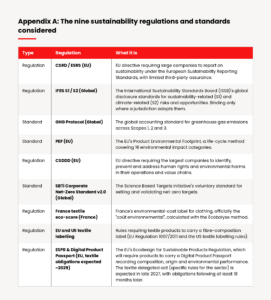
To help sustainability practitioners respond to this trend, I analyzed nine of the most pressing current and upcoming corporate sustainability standards and regulations (see Appendix A for the complete list). I found that collecting industry-aligned supply chain primary data is always a good idea. Not only can it help companies comply with these upcoming regulations, it’s the foundation of measurable, impactful, and actionable corporate sustainability work for consumer goods companies, retailers, and manufacturers.
The Greenhouse Gas Protocol’s Scope 3 accounting guidance defines primary data as “data from specific activities within a company’s value chain.”2 This is different from secondary data, which can include “industry-average data (e.g., from published databases, government statistics, literature studies, and industry associations), financial data, proxy data, and other generic data.”3
Companies can meet most sustainability regulations, most of the time, with secondary data. But here’s the thing: what regulators and stakeholders are really after, and the reason we all got into this work, is to understand how our work is reducing impacts and mitigating risks to workers and the planet over time. Without primary data, you can’t: 1) effectively quantify the impact reduction work you’ve done with your supply chain partners, or 2) integrate those carbon reductions into your greenhouse gas inventory. To state it in the affirmative: primary data is how we demonstrate the effectiveness of our work to ourselves, our supply chain partners, management, regulators, and stakeholders.
One challenge is that primary data covers so much surface area. For consumer goods companies, there are innumerable activities that could be measured as part of the creation and distribution of a product. Distinguishing between what we can measure and what we should measure with primary data is the first step in developing a solid data collection and analysis program.
One approach to developing a primary data strategy is to go line-by-line through all of the relevant regulations until you’ve assembled a spreadsheet that’s too unwieldy for anyone to follow. A better approach is to go top-down, looking for data themes and areas of overlap upon which to anchor your strategy.
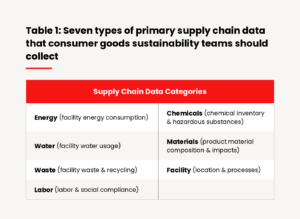
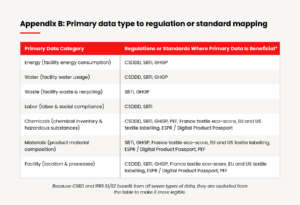
Based on my top-down analysis of the regulatory landscape, there are seven types of primary supply chain data that sustainability teams need to collect to understand the impact of their programs and prepare for their compliance and regulatory commitments. Think of these types of data as “LEGO pieces” that can be assembled into myriad outputs that range from product carbon footprints to corporate water footprints and supply chain climate risk assessments. For a full mapping of these seven types of data to the nine regulations, see Appendix B.
Having identified the types of supply chain data sustainability teams need to collect, the next challenge is operationalizing a data collection, synthesis, and reporting program. None of us have the resources to tackle this on our own. The good news is that we don’t have to because the infrastructure already exists to start collecting this data alongside your industry peers.
Back in 2009, Walmart and Patagonia realized that it made business sense for all participants in the apparel supply chain to pre-competitively define the primary data point needed to measure, evaluate, and reduce environmental impacts while improving social outcomes. This led to the development of the Higg Index tools. Fast forward to today, and these tools have expanded to cover all consumer goods, and are used by over 300 brands, retailers, manufacturers, and NGOs and tens of thousands of global facilities.
Because the Higg Index was built on common and critical business data needs, it includes many of the data points you’ll need to accelerate your compliance journey. But putting shared infrastructure in place is only the first step. Experience has taught me that it takes brands years to develop, mature, and refine a primary supply chain data collection and analysis program. This means that it’s never the wrong time to expand your data collection program.
If you take nothing else from this piece, remember that collecting industry-aligned primary data from strategic partners is always a good idea. That’s because it helps you set, manage, and adjust your sustainability strategy. Building upon a strong data collection foundation to acquire the additional data needed to adhere to a specific regulatory requirement is much easier than anchoring your data collection strategy on any specific regulation. For as we all know, sustainability regulations tend to get delayed, modified, and edited all the time. If this happens to the regulation you’ve structured your data collection strategy around, you risk losing trust with management.
Primary data is the lifeblood of corporate sustainability work. It’s how we measure, refine, and improve our programs. With this shift in compliance expectations, the data corporate sustainability teams collect can now be used to meet regulatory requirements, help identify supply chain risks, highlight business opportunities, and inform corporate strategy.
The key to unlocking all of the value, and impact reduction we all got into this work to deliver, lies in knowing what data to collect and how to use it.
Let’s get to work.


© 2026 Worldly. All Rights Reserved