

Prepare now for Digital Product Passports.
The European Union is moving toward mandatory product data labeling. Build your foundation now while policy is evolving.
The European Union is moving toward mandatory product data labeling. Build your foundation now while policy is evolving.
The EU Digital Product Passport (DPP) is a mandatory product data record required under the European Ecodesign for Sustainable Products Regulation (ESPR), applying to every product on the EU market by 2030. Exact data schemas and verification standards are still being finalized, but the underlying requirement is clear: structured, verifiable product, material, and supply chain data connected to every product record. Worldly’s Product Impact Calculator helps brands and manufacturers build that data foundation today.


Digital Product Passports will require structured product data. Today many solutions focus on the visible passport layer, not the data behind it. While exact requirements, formats, and timelines are still evolving, businesses need to build reliable product, material, and supplier data systems that meet future requirements.

units connected to purchase orders in Worldly’s Product Impact Calculator.

deadline for all products on the EU market to comply with Digital Product Passport requirements.

estimated Digital Product Passport market growth through 2034.
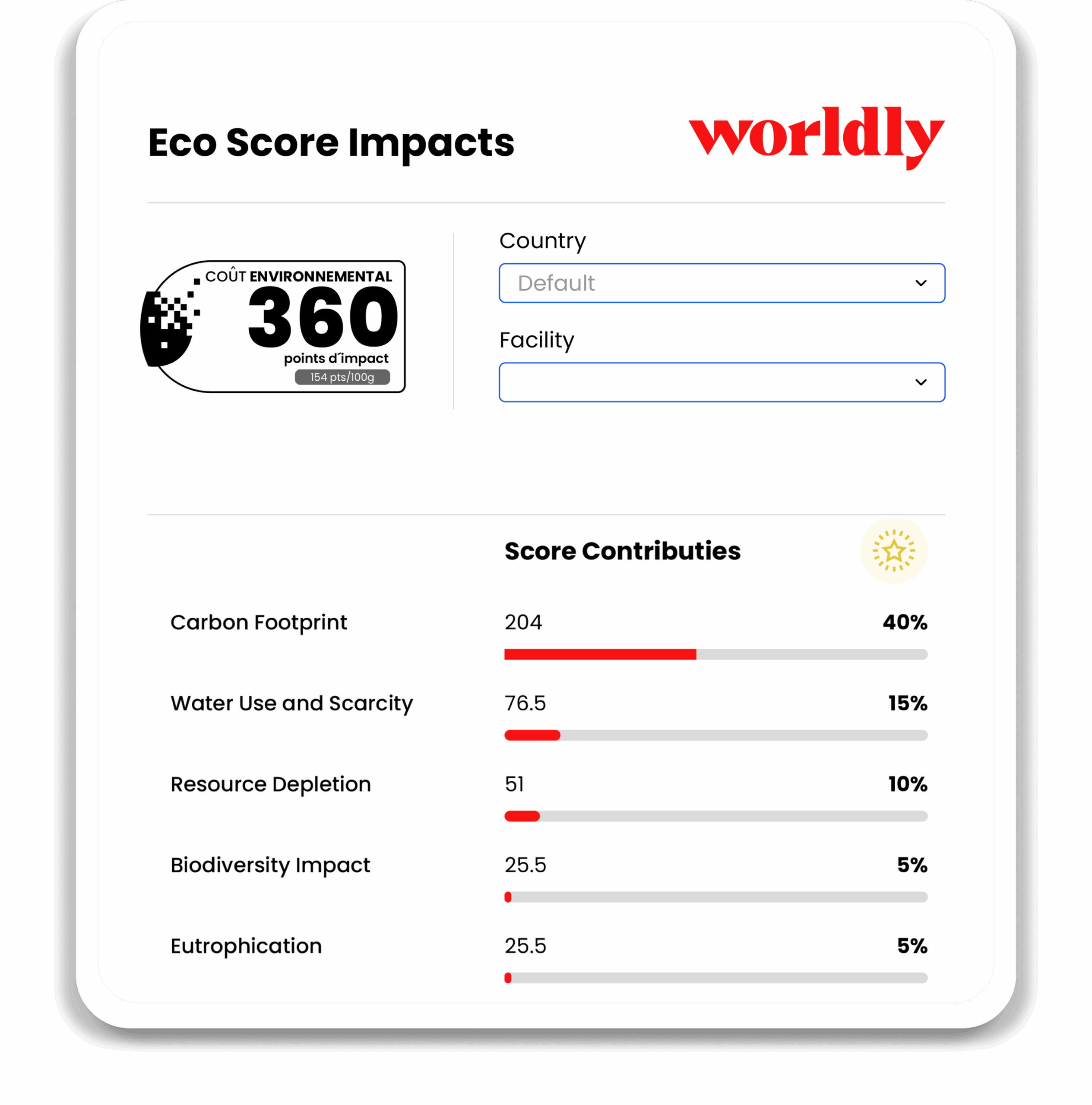
Once finalized, companies will need structured, verifiable product and supply chain data connected to every product record to comply with Digital Product Passport requirements.
Worldly’s Product Impact Calculator helps you build that foundation today, so you can generate compliant outputs as rules, schemas, and verification standards take shape.

“One of the most valuable parts of using the Product Impact Calculator is that we benefit from one consistent methodology even as we expand our data collection efforts. This means our outputs will be consistent and reliable for the future, which isn’t the case for typical lifecycle assessments.”
"Worldly’s Product Impact Calculator is the starting point for the journey to better data, better information, and better informed decisions. We now have a clearer connection between product decisions and environmental impact than we ever achieved before."
"The Digital Product Passport for textiles won't be mandatory for another couple of years, but there are still a lot of things brands can be doing now. Mapping their supply chain, looking at data they have, engaging with external partners—all of these will pay off when regulations are in force later."

1/3

The EU Digital Product Passport (DPP) is a mandatory product data record required under the European Ecodesign for Sustainable Products Regulation (ESPR) that will apply to every product on the EU market by 2030. It will require structured, verifiable product, material, and supply chain data connected to each product record. The exact data schemas, verification standards, and technical requirements are still being developed, but the 2030 deadline and the underlying data infrastructure requirements are already established.
Digital Product Passports will require structured, verifiable product-level data — including material composition, environmental impact, supply chain origin, and emissions information — connected to individual product records. While the exact schemas and verification standards are still being finalized by the European Commission, companies that already collect primary product and supply chain data for Scope 3 emissions reporting and environmental labeling purposes are building the foundation that DPP compliance will require.
Worldly’s Product Impact Calculator helps companies build the structured product and supply chain data infrastructure that Digital Product Passport requirements will demand — covering product category, materials, composition, weight, manufacturing geography, and emissions modeling. Because exact DPP schemas are still being written, Worldly helps brands establish reliable primary data systems now, so they can generate compliant outputs as technical rules take shape rather than scrambling to build data programs after final requirements are published.
The French Eco-Score (Environmental Cost) is a consumer-facing environmental impact label specific to the French market, currently entering a voluntary compliance period ahead of a mandatory effective date. The EU Digital Product Passport is a broader EU-wide product data record that will apply across product categories and member states by 2030, covering a wider range of product, material, and supply chain attributes. Both requirements draw on similar underlying product data, and Worldly Product Impact Calculator is designed to serve both.
Companies that wait for final DPP schemas and verification standards before acting will face a compressed timeline to build reliable product and supply chain data systems from scratch — typically a multi-year effort. Companies that begin structuring primary product data now, aligned to the known requirements of adjacent frameworks like Scope 3 reporting and environmental labeling, will be positioned to generate DPP-compliant outputs as technical rules are finalized rather than reacting to a hard deadline with insufficient data infrastructure in place.
See a live demo


© 2026 Worldly. All Rights Reserved


