

Stop guessing on materials impact.
Materials data is fragmented and inconsistent. Get comparable, reliable insights to make better product decisions.
Materials data is fragmented and inconsistent. Get comparable, reliable insights to make better product decisions.
Cascale’s Higg Materials Sustainability Index (Higg MSI), available through Worldly, is the most widely used materials lifecycle assessment database in the apparel, textiles, and consumer goods industry. It translates industry-submitted materials data into standardized, comparable environmental impact scores — covering carbon emissions, water use, energy consumption, and chemistry, and more — so product and sourcing teams can evaluate and compare materials without needing deep lifecycle assessment expertise.


Lifecycle assessment data is often fragmented, hard to interpret, and difficult to compare across various sources. The Higg MSI solves that.

The total emissions materials account for in the fashion and apparel industry through their extraction, processing, and production.

Average net profit increase for fashion brands that successfully partner with suppliers on sustainable materials over a five-year period.

Most widely used materials LCA database in the apparel, textiles, and consumer goods industry.
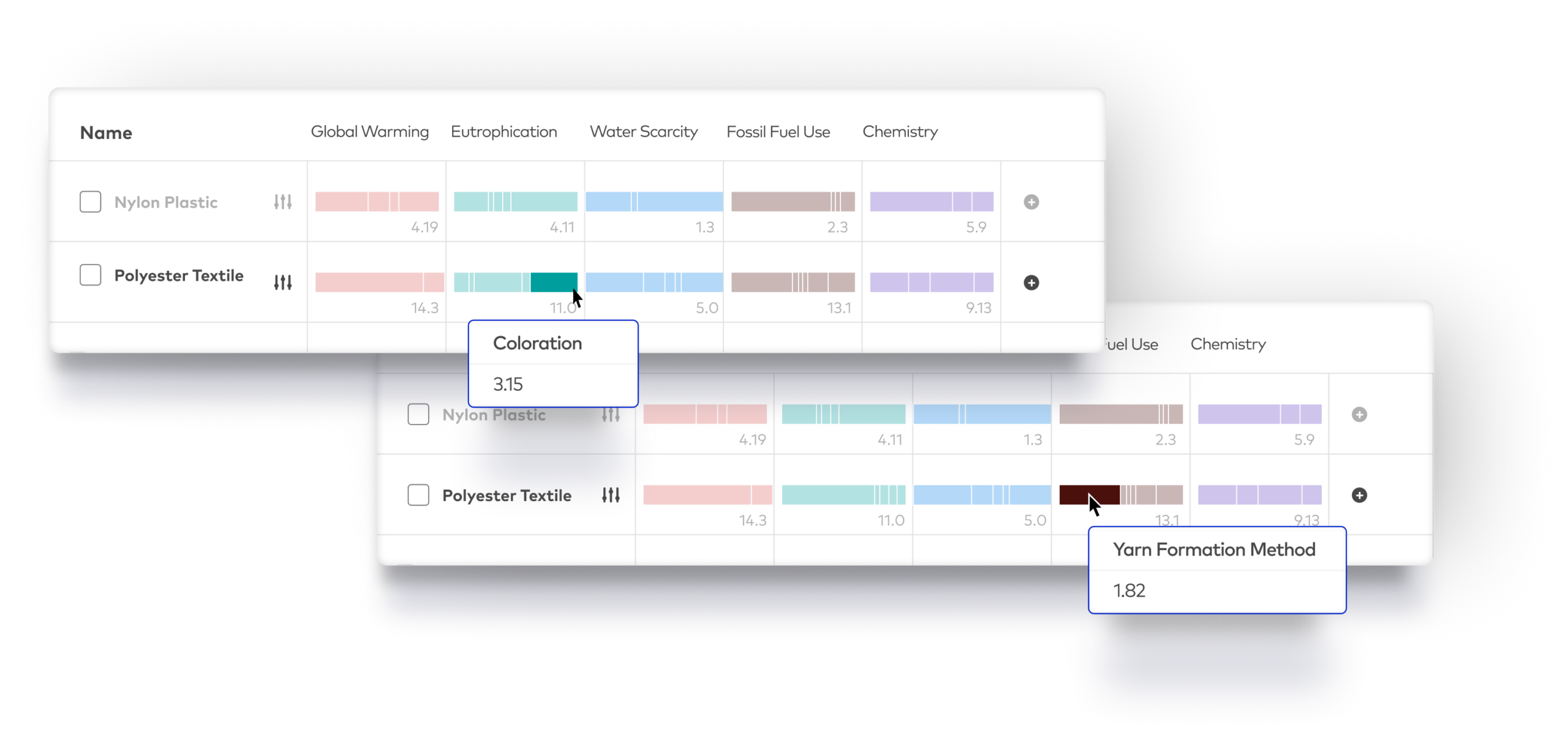

If you look at five different product lifecycle assessment service providers, you’ll get five different results because they use different emissions factors. Plus, LCAs are resource intensive, so it’s not realistic to conduct them for every product.
The Higg Materials Sustainability Index (Higg MSI), available through Worldly, is the most widely used materials lifecycle assessment database in the apparel, textiles, and consumer goods industry. It translates industry-submitted materials data into standardized, comparable environmental impact scores — covering key indicators including carbon emissions, water use, energy consumption, and chemistry — so product and sourcing teams can evaluate and compare materials without needing deep lifecycle assessment expertise.
Materials account for the majority of a product’s total environmental impact before it is ever manufactured, shipped, or sold. In the fashion and apparel industry specifically, materials account for the largest share of total emissions through their extraction, processing, and production — according to research by BCG and Fashion for Good. This means that material selection decisions made at the design stage have a greater influence on a product’s eventual emissions footprint than manufacturing processes, logistics, or end-of-life handling.
A traditional lifecycle assessment (LCA) is conducted product by product and requires significant technical expertise, time, and cost — making it impractical for teams evaluating material options across a full product portfolio. The Higg MSI provides pre-calculated, peer-reviewed impact scores for a wide range of materials, updated twice a year with industry-submitted data, so teams can compare options side by side across key environmental indicators without commissioning individual LCAs. This makes materials impact data accessible to product designers, sourcing teams, and sustainability leads who need to act on impact without deep LCA expertise.
Materials data from the Higg MSI feeds directly into product-level emissions modeling by providing standardized impact scores for the raw materials and processes that make up a finished product. Because materials account for the largest share of a typical apparel product’s Scope 3 emissions, having reliable, comparable materials impact data is essential for brands building accurate product carbon footprints, setting science-based reduction targets, and demonstrating that material substitution decisions are delivering measurable results.
Research by BCG, Textile Exchange, and Quantis found that fashion brands that successfully partner with suppliers on sustainable materials see an average net profit increase over a five-year period — evidence that materials sustainability investment is a commercial opportunity, not just a compliance requirement. Reliable, comparable materials impact data from the Higg MSI gives sourcing and product teams the information they need to identify which material shifts will deliver both emissions reductions and cost efficiency, rather than making sustainability trade-offs based on estimates.
See a live demo.


© 2026 Worldly. All Rights Reserved

