
Articles
Articles
Right-sizing a request means matching it to three factors: what you need to prove, where the facility is today, and how strategic the supplier is. Worldly is the compliance and sustainability platform that helps brands, retailers, and manufacturers prove how their products are made so they can report, comply and act.
Most sustainability, sourcing, and compliance teams have already settled the question of whether they need primary facility data. Scope 3 figures built on industry averages don’t hold up under scrutiny or support decisions. Emerging regulations and internal codes of conduct both call for proof from inside the facilities where products are actually made. Impact reduction requires a deep understanding of supply chain performance and where improvements can be made.
Knowing that collecting supply chain data is necessary, the next questions become how deep to take the request and how to do it in a way suppliers can fulfill. Covering as much of your supply chain as possible is vital for true measurement, reporting, compliance, and impact. But going beyond a core group of strategic suppliers raises the concern that one more data request adds to the assessment fatigue suppliers already experience.
What we know from manufacturers, however, is the burden they feel is rarely a function of a brand simply asking for supply chain data. Instead, it comes from mismatched and duplicate requests that don’t truly reflect what the brand needs or what the facility can realistically deliver. It also comes from one-off, proprietary assessments and audits that each facility must do on a bespoke basis.
The good news is that this problem is solvable by right-sizing your data request, which also includes accepting standardized assessments that facilities can share across customers. Keep reading to learn how Worldly customers achieve success expanding their primary data requests into their Tier 2 and Tier 3 suppliers, and beyond.
Before sending out a request for supply chain data, start with these three questions. You can use the answers to segment and prioritize your supply chain before sending the first request.
A qualitative compliance baseline is a different request than year-over-year quantitative performance tracking, which is different again from an annual record that satisfies a reporting or audit requirement. Depending on your own company’s goals and targets, regulatory requirements, and what data you need to have directly from each facility, you may need to ask the supplier to complete a different type of assessment or questionnaire.
A supplier that has completed Cascale’s Higg Facility Environmental Module (Higg FEM) for five years and already meters energy and water sits in a different place than one joining your network with no previous experience contributing their data or managing environmental expectations. You’ll have to consider the initial investment of time, bandwidth, and money that a facility needs to participate in your data collection request for the first time.
A seasonal vendor or a short-term partnership to accommodate overflow production is very different from a long-term manufacturing partner you want to build capacity over time. The relationship length, depth, and how vital the supplier is to your overall supply chain can help determine what level of request is warranted.
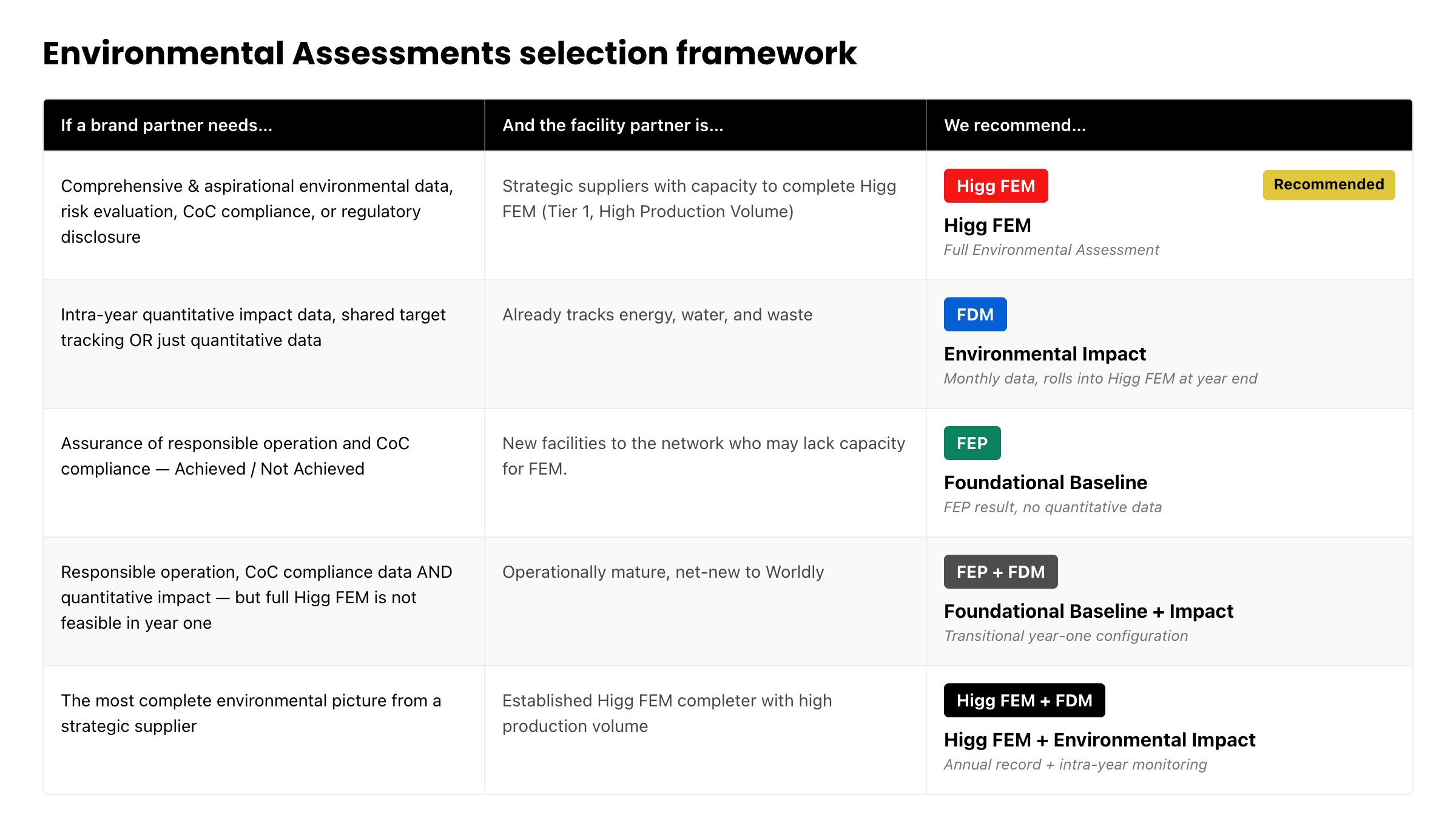
Your answers to those three questions point to different tools in the Higg Index, available through Worldly. The Higg Facility Environmental Module (Higg FEM), stewarded and governed by Cascale and delivered through Worldly’s global technology platform is one of the most comprehensive environmental assessments available. It covers energy, greenhouse gas emissions, water, waste, wastewater, and chemical management, and it delivers the annual figures teams use for reporting. The Higg FEM looks back at the previous year’s performance.
The Facility Data Manager (FDM) on Worldly offers a more frequent look at environmental impact. It captures current-year and intra-year quantitative data on energy, water, and waste management. Facilities enter data monthly and typically submit to brands quarterly, so you can work with a supplier on performance in real-time. That data rolls into the Higg FEM at year-end, which makes the annual assessment lighter and easier for facilities that keep FDM current.
A newer option, the Foundational Environmental Performance Module (FEP Module), covers the industry-aligned essentials of responsible operation.This new module was developed by Cascale in collaboration with 80 stakeholders to establish a baseline for facility environmental management. FEP consists of a subset of Higg FEM questions, with no quantitative component. Every facility completing a Higg FEM also completes an FEP evaluation, but FEP can stand alone for suppliers where this baseline is genuinely what you need.

“I think of the Higg FEM like a résumé. It’s a profile of how the facility is performing. And if you think about yourself, your résumé is who you are. You don’t change it that often. It’s so helpful to be able to submit the same resume every time.”
Brands want collaborative, win-win relationships with their suppliers. They may worry that over-requesting supply chain data will erode that goodwill. However, the strongest case for right-sizing your data requests isn’t just about keeping everyone happy. It’s first and foremost about the integrity of the data you get back from those requests.
Alaaddin Okur, Director at Minerva Sustainability, has been working with the Higg FEM since 2015. Through his years working at manufacturers and verifying bodies, he’s seen firsthand how a facility’s capacity is the constraint that causes data quality to suffer.
“Most small units don’t have a sustainability team. Usually one person does everything. So when you ask them for a full Higg FEM, it’s just too much for them — and the quality of the answers directly drops.”
A thin or rushed Higg FEM doesn’t serve anyone. Facilities spend weeks or months producing data that their brand customers may not be able to defend. Lower quality, rushed, or under-resourced data collection efforts also can’t be used to report on, or act on, true risks within the supply chain.
An alternative to this is asking these facilities to complete the Foundational Environmental Performance Module (FEP Module).
Okur frames the FEP Module as the entry point for facilities new to the Higg Index — “a kind of warm-up,” as he put it, that works in both directions. Facilities learn what brands expect of them. Brands get a first read on where a new supplier actually stands.
From there, Worldly’s Facility Data Manager (FDM) is the natural next step for smaller facilities because it adds the quantitative data and greenhouse gas calculation that FEP does not include. Once a facility has systems in place to track that data, a full Higg FEM becomes realistic rather than aspirational. Brands that have worked with Worldly for years typically run the full Higg FEM across thousands of facilities — over 21,000 facilities completed the Higg FEM 2025 assessment..
This progressive approach, moving from FEP or FDM, to a full Higg FEM, follows a supplier’s capability instead of forcing it. Brands that have worked with Worldly for years typically run the full Higg FEM across thousands of facilities — many of whom also contribute their social & labor and chemical data through Worldly — but they didn’t start there, and they understand the nuances of different facilities within their supply chain.
A shared assessment reduces duplicate work because a facility completes and verifies its data once, then chooses which brand partners to share it with. Facilities own their data and control that decision.
Okur describes the reason so many primary data collection efforts fail: Every brand customer sends its own request, often on a different platform, each with its own format and timeline. When the number of requests feel unachievable, suppliers get discouraged and the likelihood of completing any assessment drops.
On the other hand, right-sizing your request and choosing a shared assessment framework can be key to success because:
There’s a practical speed advantage, too. When a brand brings its facility list into Worldly, it typically finds a significant portion of those facilities are already in the network of over 45,000 global suppliers. This means the ask of suppliers is often “please share what you’ve already done” rather than “please complete something new.” This degree of supplier network coverage means brands new to the Worldly ecosystem begin receiving primary environmental data from their supply chain within 90 to 120 days, not the 12-month industry average.
Facilities also aren’t working alone. The AI-powered Worldly Assistant answers questions inside the assessment itself in the preferred language of the user, drawing on the full How to Higg guidance and the ZDHC knowledge base, so facilities don’t navigate away mid-completion to hunt for answers (and possibly abandon the questions altogether).
Training is also available in multiple languages, and Worldly hosts live expert Q&A sessions to address section-level sticking points. Meanwhile, Worldly’s Insights Hub benchmarks a facility’s performance against peers.
Choosing the right sustainability assessment for suppliers reduces the burden on them. It doesn’t replace the essential brand-supplier relationship.
Okur’s advice to brands new to this work is to get their teams into the field — shadow Higg FEM verifications and FDM validations, and understand the processes behind the numbers before the first request goes out. He also makes a case for brands designing training for suppliers ahead of any first-time data request, rather than after the questions start coming in.
“Brands need to work together. On sustainability, they shouldn’t see each other as competitors. They can run joint trainings and plan shared verification calendars. That means less duplication, less pressure on suppliers, and better data in the end.”
Loretta Tam, VP of Supplier Engagement at Worldly, draws the same conclusions from her experience helping hundreds of brands engage tens of thousands of suppliers over the last decade. Brands that are visibly present in their supply chains — explaining why they’re asking for specific data, why it matters, and delivering training alongside Worldly — see stronger participation and higher-quality data than brands that just send requests and then disappear. One of Tam’s top pieces of advice to brands is to meet facilities where they are and help them develop over time to ultimately meet your own supply chain goals.
The bottom line: Asking suppliers for the right data at the right time, along with communicating to them the reasons (and value) behind your requests leads to more successful results regardless of which assessment you choose to ask for.
Want to learn more? Watch the full webinar replay.
Supplier assessment fatigue is the burden suppliers feel when they receive too many data requests, often duplicated across brands and mismatched to what the facility can realistically deliver. It is usually caused by the design of requests rather than their frequency. Right-sizing each request, and sharing assessments a facility has already completed, reduce that load while keeping the data brands need.
Answer three questions before choosing what to request: What do you need to prove, where is the facility today, and how strategic is the supplier? Those answers point to the Higg FEM for annual environmental data, the Facility Data Manager (FDM) for current-year quantitative tracking, or Foundational Environmental Performance (FEP) for an environmental performance baseline. Smaller or newer facilities often benefit from starting with the FEP Module.
The Higg Facility Environmental Module (Higg FEM) is a comprehensive annual assessment covering energy, greenhouse gas emissions, water, waste, wastewater, and chemical management. Foundational Environmental Performance (FEP) is a subset of Higg FEM questions with no quantitative component. Every Higg FEM includes an FEP evaluation, but the FEP Module can stand alone when a baseline is what you need.
A shared assessment lets a facility complete and verify its data once, then choose which brand partners to share it with. Each additional share spreads assessment and verification costs across more partners. Brands reviewing the same assessment also catch discrepancies that one brand alone might miss, and suppliers avoid repeating work for every new customer.
Brands can explain why they are asking for data, offer training along with each request, and join field work such as shadowing Higg FEM verifications and FDM validations. Running joint training sessions with other brands and planning shared verification calendars further reduce duplication. Worldly supports suppliers with multilingual training, live expert Q&A sessions, and the Worldly Assistant inside assessments.


© 2026 Worldly. All Rights Reserved


