
Articles
Many compliance programs run on scattered audit files, email threads, and spreadsheets, and that fragmentation is where the risk sits. Centralizing audits, findings, and corrective action plans (CAPs) in one shared system closes that gap. Many brands think they have a program that works for now. Audits get scheduled, findings get logged, and CAPs eventually close. When records live in inboxes and only one person knows where they are, a vacation or departure can slow the work down at best. At worst, a remediation issue goes unnoticed, and that can turn into a significant problem for the company.
From the outside, a compliance program can look solid. But risks and gaps can still hide underneath the surface, undiscovered until a key team member’s departure or a regulator’s question exposes records that were never connected. A centralized program is the solution: It ties the pieces together before the stress arrives.
Sourcing teams, compliance leads, and executives all need answers to the same questions: Which suppliers carry risk, whether that risk is being addressed, and how compliant the supply chain is.
Compliance audits themselves are rarely the point of failure. Rather, it’s everything that comes after the audit that can slow down the process and introduce risk. When audit findings arrive as PDFs from several sources, teams spend weeks copying them into code of conduct spreadsheets before they can compare suppliers’ results. Even worse, each reporting cycle repeats the same manual work.
Social, environmental, and chemical data often live in separate tools. Audit results from the Higg Facility Social & Labor Module (FSLM), third-party audits, and proprietary frameworks each use different structures. That makes them hard to normalize, and the result is no single view of a supplier’s risk.
When teams copy findings by hand, interpretation depends on who reads the report. One reviewer may classify a working hours issue differently than another. That inconsistency makes it harder to defend decisions to auditors, regulators, and NGOs.
Corrective action plans often move through email, text, and messaging apps. Suppliers receive overlapping requests from several brands, and progress stalls long before findings close. Without a system of record, nobody can easily show who owns a CAP, what evidence was submitted, or when it closed.
In many organizations, compliance knowledge sits with one or two people. They know which supplier’s audit is overdue, which CAP needs a follow-up call, and where the evidence for a closed finding lives. This system works well until the only people with deep institutional knowledge become unavailable. In an instant, reliance on one or two internal experts can derail vital processes and create unnecessary compliance risk across your supply chain.
Leaders experience their own pain points from the way supply chain compliance works at many companies. Without a shared view of a single source of truth, a senior leader who asks how many CAPs are outstanding, which are overdue, or which high-risk suppliers are improving may wait days for an answer. No matter how well a program is designed, its success hinges on an individual’s availability. No one would say this is ideal. .
A centralized program moves knowledge out of individual inboxes and into a shared system. Audits, findings, and CAPs sit in one environment, with ownership, deadlines, and evidence attached. Anyone with access can see where a supplier stands without relying on the person who happens to remember.
Worldly Supplier Compliance Management brings Higg FSLM results and third-party audits, including SMETA, BSCI, WRAP, Better Work, and ERSA, into a single environment. Verified environmental assessments from Higg Foundational Environmental Performance (FEP) are also ingested to bring both social and environmental compliance together.
AI-powered mapping aligns findings to the framework a brand chooses, whether that is its own Code of Conduct, Cascale Risk Categorization, or ILO Core Labour Standards. The same logic applies across all facilities, so teams compare suppliers like-for-like, even when audit sources differ.
Where manual framework mapping slows teams down, Worldly maps findings to the brand’s standards automatically. The outcome is faster interpretation and fewer missed alignments.
Teams create and track corrective action plans on the platform. They can send automated communications with clear remediation requirements, set owners and deadlines, and monitor completion without exporting data.
Automatic reminders and closure workflows can reduce the manual follow-up that consumes so much compliance time. Evidence-backed closure helps teams keep a record that holds up when someone asks questions later.
A centralized program gives leaders a live view of remediation. A portfolio-level CAP dashboard shows every open plan in one place, with status, ownership, risk level, and progress. Leaders can filter by compliance classification, severity, facility, or overdue status to see which items need their attention most.
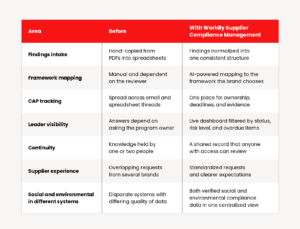
This newfound visibility changes how leaders and compliance teams make decisions. Instead of waiting for a summary, a leader can see which high-risk suppliers have overdue CAPs and direct resources to those first. Effort goes where risk is highest, based on supplier scoring rather than on whoever raises the issue most loudly.
Simone Colombo, Head of Corporate Sustainability at OVS, describes how the platform gives the team “a much clearer picture of where risk exists.”
The amount of time each team saves depends on the specifics of its program, but there’s no denying that automated workflows can shorten the time between a finding and a verified fix.
Scale is where centralization can pay off most. Brands often work with hundreds or thousands of facilities, and when they manage each one by hand, they’re limited by their manual capacity and increase the risk of error. This means teams that manage compliance manually can’t go as deep into their supply chain as they’d like, often stopping before they reach the riskiest upstream suppliers. A centralized system helps teams deploy assessments, follow up, and track progress across the supply base while keeping full visibility, and do so at a scale they could never achieve by hand.
Suppliers also benefit from a centralized and automated compliance management system. Many facilities already complete Higg FSLM, Higg FEP, or other accepted assessments. Bringing those results into one environment reduces duplicate requests, so suppliers spend less time on repeat audits and more time on the improvements that matter.
Most brands are good at finding compliance issues but identifying the risk only gets you halfway. True compliance is about taking the action to address those issues, and being able to prove it. Knowing about a risk but not taking action can expose a brand to legal and regulatory penalties, reputational damage, and commercial risks. And as regulatory pressures increase, it’s critical that the due diligence workflow produces evidence of compliance.
Explore how Worldly Supplier Compliance Management can help your team build a strong compliance program that delivers when leaders and regulators ask.
Schedule a demo to see Worldly’s Supplier Compliance solution in action.
Worldly’s Supplier compliance management solution helps brands to prove due diligence and prioritize compliance programs. It tracks supplier audits, findings, and corrective action plans in one system of record. It gives brands a traceable record of how each issue was identified, assigned, and closed, which supports supplier due diligence requirements.
Brands track corrective action plans (CAPs) by assigning each one an owner, a deadline, and required evidence in a shared system. Status views show which CAPs are open, overdue, or closed, so teams can follow up before deadlines pass.
The EU Corporate Sustainability Due Diligence Directive (CSDDD) requires qualifying companies to identify and address adverse human rights and environmental impacts in their value chains and to show evidence of doing so. A centralized program keeps audits, findings, and remediation records together, so that evidence can be produced quickly.
Programs often stall at the follow-up stage. Findings are copied by hand, corrective action plans move through email, and evidence sits with individuals. Without a system of record, teams struggle to show who owns each action, what evidence was submitted, and when it closed.


© 2026 Worldly. All Rights Reserved

