

Better data. Smarter sourcing.
Standardized environmental data across your supply chain — so you can benchmark, improve, and report with confidence.
Standardized environmental data across your supply chain — so you can benchmark, improve, and report with confidence.
Worldly helps brands and retailers collect standardized environmental data from their supply chains through the Higg Facility Environmental Module (Higg FEM), stewarded and governed by Cascale and implemented globally through the Worldly sustainability and supply chain intelligence platform. Accepted by 300+ brands and retailers globally, the Higg FEM gives manufacturing facilities one consistent way to report energy use, water consumption, waste, and chemical management — replacing fragmented questionnaires with comparable, credible data.


Manufacturers are already tracking environmental impact, from emissions to water use. But when every brand sends different questionnaires on different timelines, the result is duplicated effort, inconsistent outputs, and data you can’t compare or act on. A shared, standardized approach reduces supplier burden — and provides you consistent, comparable data that makes progress possible.

of facilities on Worldly actively track
energy use, a common
blindspot globally.

of facilities on Worldly know which processes use the most energy.

of facilities on Worldly have set targets to improve energy use.

Collecting environmental data from suppliers is time-consuming when every brand asks differently. A standardized assessment — the Higg Facility Environmental Module — gives your supply chain one credible, consistent way to report, accepted by 300+ brands and retailers globally.
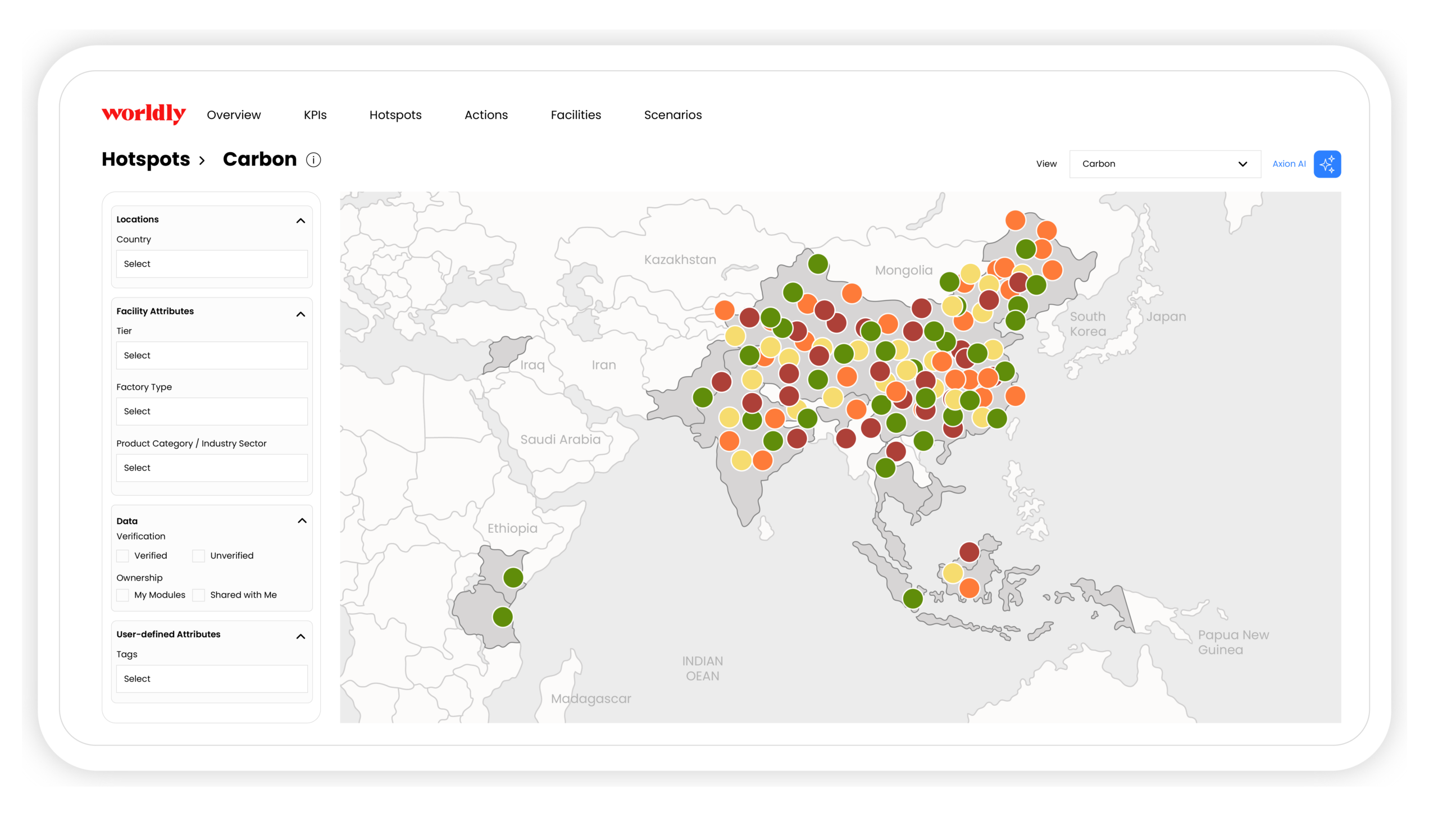
Standardized data is only valuable if you can analyze it. Worldly Axion aggregates primary environmental data across your entire supplier base and surfaces the insights that tell you where performance stands, where the gaps are, and where to direct your next move.

Supply chain environmental impact doesn’t average out neatly across a product portfolio. Worldly’s Product Impact Calculator uses primary facility data to show you exactly where emissions and resource use are concentrated — by material, process, and supply chain stage.

Without a common framework and platform, Tier 1 suppliers face a fragmented landscape of many-to-many business relationships. This results in redundant reporting, inconsistent data, and overlapping deadlines. Worldly and the Higg Index resolve this by standardizing both the data and the timing for all actors, significantly reducing audit fatigue and administrative burden across the entire supply chain.
"We can’t achieve our goals of zero waste and net-zero emissions by 2040 if we don’t know where we are today. Worldly gives us the ability to collect primary data across our entire supply chain, it makes it easy for our partners to enter their data without heavy lifting, and it’s aligned to industry standards and accepted frameworks."

1/2

Brands collect standardized environmental data from their supply chains through the Higg Facility Environmental Module (Higg FEM), stewarded and governed by Cascale and implemented globally through the Worldly sustainability and supply chain intelligence platform. The Higg FEM gives manufacturing facilities one consistent way to report energy use, water consumption, waste generation, and chemical management — accepted by more than 300 brands and retailers globally — replacing the fragmented questionnaires that create duplicate effort for suppliers and inconsistent outputs for brands.
A: When brands send different environmental questionnaires on different timelines, the data that comes back is inconsistent in methodology and format — making it impossible to compare performance across suppliers, identify where emissions or resource use are concentrated, or demonstrate credible progress to stakeholders and regulators. Standardized data from a shared framework like the Higg FEM produces comparable outputs across every participating facility, giving brands the consistent baseline they need for benchmarking, regulatory disclosure, and supplier engagement decisions.
Worldly tracks environmental performance across four primary areas at the facility level: energy use and carbon emissions, water consumption and wastewater management, waste generation and disposal, and chemical management. Platform data shows that approximately 92% of facilities on Worldly actively track energy use, around 72% know which processes consume the most energy, and approximately 67% have set targets to improve energy use — reflecting a progression from measurement to strategic action that standardized data infrastructure makes possible.
Worldly Axion aggregates primary environmental performance data across a brand’s entire supplier base and surfaces the insights that show where performance stands, where gaps are concentrated, and where to direct resources for maximum impact. Where the Higg FEM produces facility-level data, Worldly Axion provides the analytical layer that turns that data into actionable intelligence — identifying hotspots by region, facility, or production tier, and connecting facility-level performance to climate, regulatory, and geographic risk context.
Facility-level environmental data from supplier assessments provides the primary input that makes product-level emissions modeling accurate. Worldly’s Product Impact Calculator uses primary facility data to show where emissions and resource use are concentrated by material, process, and supply chain stage — giving brands visibility into their Scope 3 footprint that spend-based estimates and industry averages cannot replicate. This connection between facility data and product-level emissions is what enables brands to identify specific hotspots, set credible reduction targets, and prove progress over time.
See a live demo


© 2026 Worldly. All Rights Reserved


